
The Challenge of Designing an Open Plan Space (And How to Get It Right)
- Mar 7
- 3 min read

In Miami—especially in neighborhoods like Brickell, Miami Beach, and Coconut Grove—open plan living has become the default. Developers prioritize sweeping views, expansive glazing, and continuous great rooms that blur the lines between kitchen, dining, and living.
On paper, it sounds ideal.
In reality, open plan spaces are some of the most challenging environments to design well.
When everything is visible at once, everything matters. And without thoughtful planning, what was meant to feel expansive can quickly feel undefined, noisy, or chaotic.
Here’s why open plan spaces are so complex—and how to approach them with intention.
The Illusion of “More Space”
Open concept living promises freedom and flow. But square footage alone doesn’t create comfort.
The most common issue?
A lack of spatial definition.
Without walls to anchor the eye, the room can feel:
Floaty
Overexposed
Acoustically harsh
Visually cluttered
Or strangely empty
The paradox of open plan design is this: The more open the space, the more structure it actually requires.
Challenge #1: No Natural Boundaries
Walls do more than divide rooms—they provide psychological containment. Remove them, and you remove natural stopping points for furniture placement, lighting, and art.
How to overcome it:
Create invisible architecture.
This can include:
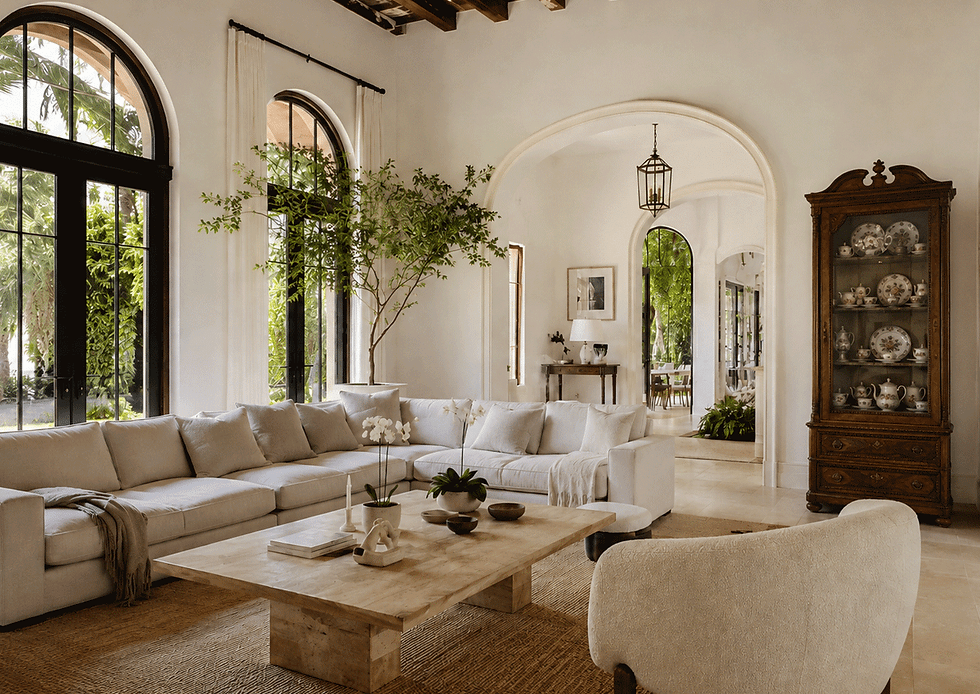
Area rugs to ground each zone
Ceiling treatments to subtly define spaces
Strategic lighting plans (pendants over dining, sculptural fixtures over seating)
Millwork that acts as a visual anchor
Thoughtful furniture placement that establishes clear conversation areas
In high-end residential design, zoning is rarely obvious—but it is always deliberate.
Challenge #2: Competing Focal Points
In an open plan layout, you might have:
A kitchen island
A fireplace
A media wall
Floor-to-ceiling windows with ocean views
When everything competes, nothing wins.
How to overcome it:
Choose a hierarchy.
Ask:
What is the primary focal point?
What is secondary?
What should visually recede?
Design is about editing. In a Miami condo overlooking the water, the view should lead. That may mean softening cabinetry finishes, minimizing visual clutter in the kitchen, and avoiding statement pieces that fight for attention.
Luxury spaces feel calm because they are disciplined.
Challenge #3: Acoustics
Hard flooring, high ceilings, and glass walls—common in modern Miami residences—create echo and noise transfer. The result can feel cold and overstimulating.
How to overcome it:
Layer in softness intentionally:
Upholstered seating
Textured drapery
Custom rugs
Acoustic wall panels disguised as art
Fabric-wrapped millwork panels
The goal isn’t just beauty. It’s comfort.
A well-designed open plan space should feel expansive—but still intimate.
Challenge #4: Furniture Scale & Proportion
Too-small furniture will look lost.
Too-large pieces will block circulation and create tension.
In open concept spaces, scale is everything.
How to overcome it:
Use substantial anchor pieces (a properly scaled sectional, a generously sized dining table).
Float furniture away from walls.
Maintain consistent sight lines.
Ensure there is enough negative space for flow.
In luxury interiors, generosity of scale signals confidence. But it must be balanced.
Challenge #5: Cohesion Without Monotony
An open space must feel unified—but not repetitive.
When every room is visible at once, finishes must relate to each other without becoming predictable.
How to overcome it:
Establish a clear material palette early.
Repeat tones in varied ways (stone in the kitchen, a similar veining in a cocktail table).
Use texture to create variation.
Allow one or two moments of contrast for depth.
Cohesion creates calm. Contrast creates interest. The art is in balancing both.
The Real Secret to a Successful Open Plan
Open plan design isn’t about removing walls.
It’s about creating rooms without building them.
The most successful spaces feel effortless, but they are carefully choreographed—every sightline, every material transition, every lighting choice working in harmony.
When done well, an open plan home feels:
Expansive but grounded
Social but intimate
Elegant but livable
And in a city like Miami—where architecture often gives you a beautiful shell—the interior design is what gives the space structure, warmth, and identity.
Thinking About Reimagining Your Open Plan Space?
If your home feels undefined, overly exposed, or simply not functioning the way it should, it may not be a layout problem—it may be a design strategy problem.
At Brickell Interiors, we approach open plan spaces with intention, clarity, and restraint—so they feel curated, calm, and distinctly yours.
If you're ready to transform your space into something that truly fits how you live, let’s start the conversation.


Comments