
Branded Luxury Condos in Miami: Are Buyers Paying for Timeless Design—or Just the Logo?
Updated: May 31
Written by Cynthia McFarlane
A little over a year ago, I wrote about the rise of branded luxury residences in Miami and questioned whether these projects were truly smart investments, or simply highly sophisticated marketing.
Since then, the landscape has evolved considerably.
Some branded towers are progressing toward completion. Others are still navigating approvals. And some, like Mercedes-Benz Places in Brickell, have encountered financial turbulence that raises broader questions about the long-term stability behind the branding itself.
But beyond the economics, another shift has become increasingly apparent to me as an interior designer:
Many of these branded luxury condos in Miami are beginning to look remarkably similar.

Miami’s Luxury Condo Market Has Become Increasingly Brand-Driven
In Miami real estate, branding sells aspiration as much as architecture.
Developers understand that attaching a globally recognized fashion house, automobile manufacturer, or luxury hospitality brand to a condominium instantly creates prestige and marketability. From Porsche and Armani to Bentley, Dolce & Gabbana, and Mercedes-Benz, branded residences have become a defining feature of Miami’s luxury skyline.
But somewhere along the way, many of these interiors began converging into the same aesthetic formula.
Walk through enough branded residences in Brickell, Downtown Miami, Sunny Isles or Miami Beach today, and certain themes start repeating themselves:
Creamy monochromatic palettes
Dramatic stone slabs
Bronze accents
Curved furniture silhouettes
Atmospheric lighting
Spa-inspired bathrooms
Hospitality-style amenity spaces
Carefully curated “quiet luxury” minimalism
The spaces are polished. Luxurious, even.
But increasingly, they feel interchangeable.

The Hospitality Influence on Luxury Residential Design
Part of this comes from the growing influence of hospitality design in luxury condominiums.
Many branded residences are intentionally designed to evoke the feeling of a five-star hotel or private members club. The lobbies, lounges, spas, and even the residences themselves are curated to feel globally recognizable and immediately marketable to affluent international buyers.
That strategy works extremely well from a sales perspective.
But homes are fundamentally different from hotels.
Hotels are designed to appeal to the broadest possible audience. A home should reflect the person living inside it.
And that’s where many branded condo interiors in Miami begin to fall short.

The Biggest Misconception About Branded Residences
One of the biggest misconceptions buyers have is believing that purchasing a branded residence means the interior design work is already done.
In reality, even after paying a significant premium for the branded experience, most owners still invest heavily in personalizing the space after closing.
Because true luxury is personal.
The developer-designed interiors are often intentionally neutral and broadly appealing. Developers need mass desirability at a global scale, which usually results in interiors that are visually safe, trend-conscious, and easy to market, but not necessarily deeply individual.
As interior designers, we often walk into these units and immediately begin softening the “showroom effect.”
The spaces may feel elegant initially, but they frequently lack warmth, layering, personality, and emotional connection. Many feel designed for marketing renderings rather than real day-to-day living.
As a result, clients still end up investing substantially in:
Custom millwork
Architectural lighting design
Furnishings and art curation
Wall treatments and textiles
Bespoke closets and kitchens
Layout modifications
Material refinements
More nuanced layering and texture
Because ultimately, no luxury brand can fully design a home for someone they’ve never met.
Mercedes-Benz Places and the Risk Behind the Branding
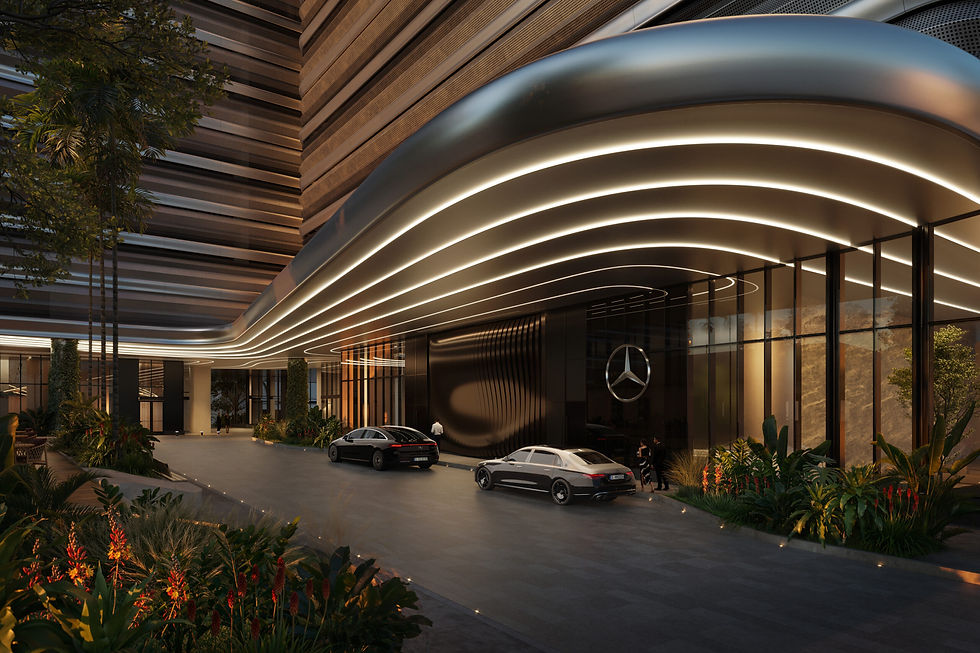
The recent issues surrounding Mercedes-Benz Places in Brickell also highlight another important reality: branding alone does not guarantee long-term value or stability.
The highly publicized development has reportedly faced foreclosure proceedings tied to major financing issues, contractor liens, and construction-related uncertainty. While the project may still move forward, the situation underscores an important point for luxury condo buyers:
A globally recognized brand name does not eliminate development risk.
And from a design perspective, it raises another question entirely:
If the branding disappeared tomorrow, would the building itself still feel exceptional?
The Rise of Design-Driven Luxury Towers in Miami
Interestingly, some of Miami’s most compelling new luxury towers are moving away from branding altogether.
Projects like 1428 Brickell are positioning themselves around architecture, craftsmanship, innovation, sustainability, and location rather than borrowed brand identity.
That feels significant.
Because truly timeless luxury has never really depended on logos.
It depends on:
Exceptional architecture
Natural light
Thoughtful layouts
Enduring materials
Layered interiors
Emotional connection
A sense of individuality
And increasingly, some branded interiors already feel tied to a very specific moment in design culture: the early-2020s obsession with highly stylized “quiet luxury” minimalism.
The question is whether those interiors will age gracefully or begin to feel overly thematic and dated.
The Future of Luxury Interior Design in Miami
This may ultimately become the biggest challenge for branded residences from an interior design standpoint.
Fashion trends evolve quickly. Luxury branding evolves quickly. What feels aspirational today can feel overdone surprisingly fast.
The strongest interior design tends to transcend trend cycles altogether.
That doesn’t mean branded luxury condos are inherently bad investments. Some are beautifully executed and thoughtfully designed. Some genuinely integrate architecture, interiors, and amenities in meaningful ways.
But buyers should ask themselves an important question:
Am I investing in timeless design, or am I simply buying into a luxury marketing narrative?
Because no matter how polished the developer finishes may be, creating a truly luxurious home still requires personalization, restraint, authenticity, and a deep understanding of how the client actually lives.
And that part cannot be branded.
Designing Beyond the branding
At Brickell Interiors, we specialize in transforming luxury condos in Miami into deeply personal homes that feel timeless, layered, and highly individualized. Whether you’re purchasing in a branded residence or a more architecture-driven tower, thoughtful interior design is what ultimately turns a beautiful space into a meaningful one.
Because in the end, the most timeless luxury interiors don’t represent a brand.
They represent the people who live there.
Schedule a consultation with Brickell Interiors to discuss how we can elevate your space beyond the branding.


Comments